
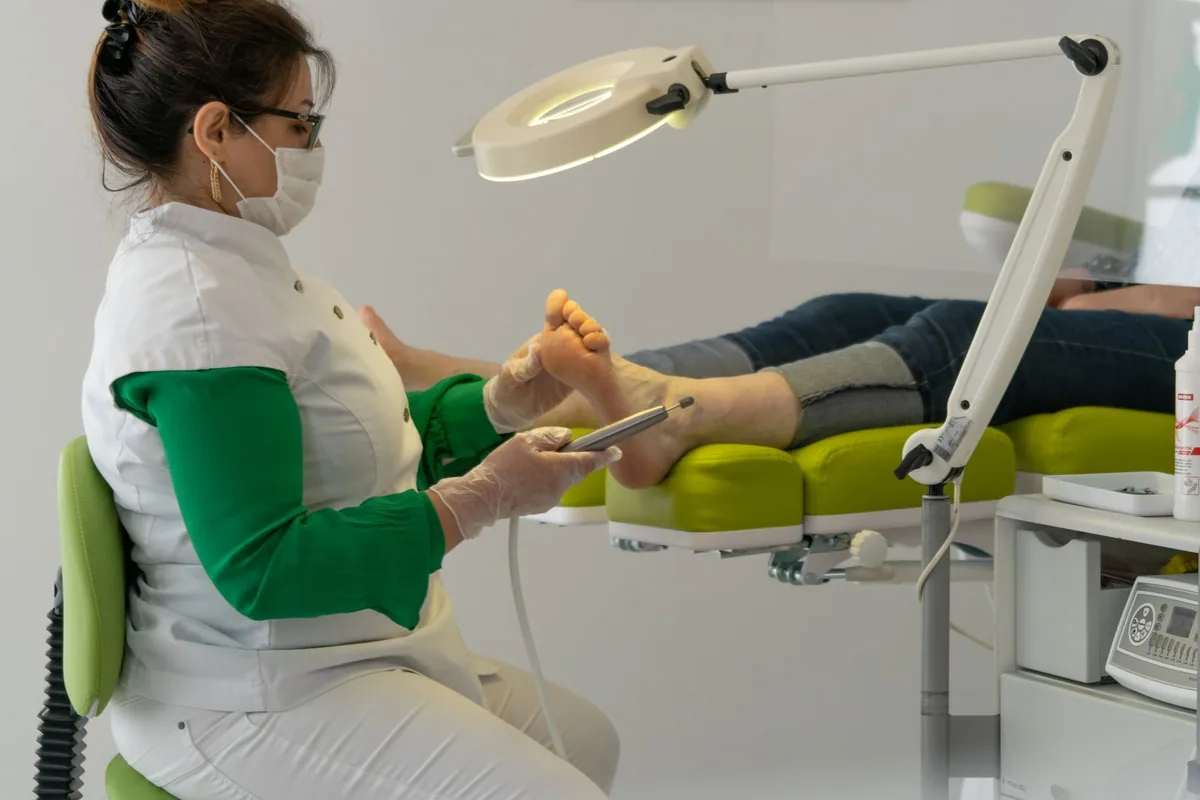
A small stone in your shoe bothers anyone within a few steps. Someone with diabetes whose foot nerves are damaged can walk on it all morning without noticing, and find a wound on the sole that evening. Many diabetic foot problems start like this, with a small injury that does not hurt, that nobody sees in time and that then takes a long time to heal.
14 November is World Diabetes Day, and for 2026 and 2027 the International Diabetes Federation has chosen the theme of acting early (Early action on diabetes). For the feet, acting early means looking at them every day, not ignoring a callus or a rub, and having a diabetic foot check with a podiatrist before an ulcer appears. Below we go through what diabetes does to the feet, which signs should never be ignored, and which kinds of care, check-ups and footwear prevent most problems.
In this article
The essentials in one minute
- Diabetic foot covers the problems diabetes causes in the foot: loss of sensation from neuropathy, poor circulation, calluses that turn into an ulcer, infections and, in severe cases, amputation.
- According to the international IWGDF guidelines, between 19% and 34% of people with diabetes will have a foot ulcer at some point in their lives.
- The most protective habits are simple: check your feet every day, never walk barefoot, not even at home, and wear shoes that neither squeeze nor rub.
- No hot-water bottles, heaters or braziers to warm your feet: with reduced sensation, the skin can burn without you noticing.
- Podiatry checks range from once a year, if the foot is healthy, to every one to three months if there has already been an ulcer.
- A red, hot, swollen foot or a wound that is not getting better needs to be seen the same day, even if it does not hurt.
What diabetic foot is
The International Working Group on the Diabetic Foot (IWGDF), which publishes the reference guidelines used worldwide, uses the term diabetic foot for any of these problems in the foot of a person with diabetes: peripheral neuropathy, peripheral artery disease, infection, ulcer, Charcot neuro-osteoarthropathy, gangrene or amputation. The most common and most worrying complication is the diabetic foot ulcer, a wound that goes through the skin, almost always in an area under a lot of pressure, and is slow to close.
Diabetes is very common. The World Health Organization estimates that 830 million people were living with it in 2022, 14% of the world's adults and twice the 1990 figure, and points out that many have foot problems that can lead to ulcers and amputation. In Spain, the di@bet.es study, with data from 2009 and 2010, found diabetes in 13.8% of adults, and nearly half of them did not know they had it.
How many people end up with an ulcer
The 2023 IWGDF guidelines estimate that between 19% and 34% of people with diabetes will develop a foot ulcer at some point in their lives, and that around 2% develop one each year. Once healed, it comes back very easily: 40% of people have another within the first year and 65% within three years.
It is not just a foot problem. An analysis published in 2020 in the Journal of Foot and Ankle Research found that, five years after an ulcer, 30.5% of patients had died, a figure similar to that for all cancers combined (31%). The authors concluded that ulcers and amputations are more than a reflection of poor health: they are themselves associated with premature death.
The risk, however, is not the same for everyone. According to the IWGDF, people with diabetes who keep normal sensation and circulation and have no foot deformities do not appear to be at higher risk of ulcers than people without diabetes. And well-organised foot care could prevent up to 75% of ulcers.
Why diabetes damages the feet
Over the years, too much glucose in the blood damages nerves and blood vessels. In the foot, these two kinds of damage add to something people rarely think about: it is the part of the body that carries the most weight and rubs the most against footwear.
Nerves: a foot that stops warning you
Diabetic neuropathy makes the foot lose what the guidelines call protective sensation: it no longer feels a stone in the shoe, a seam that rubs or water that is too hot. The skin also tends to dry out and crack, and every crack is a way in for bacteria. Neuropathy sometimes causes tingling, burning or pins and needles; sometimes it causes no symptoms at all.
Arteries: less blood, poorer healing
Peripheral artery disease is the narrowing of the arteries in the legs, almost always due to atherosclerosis, the same plaques that block the arteries of the heart. According to the IWGDF, it is present in up to half of people with an ulcer and is a major risk factor for poor healing, gangrene and amputation. Its typical symptom is intermittent claudication: pain in the calf when walking that forces you to stop and eases with rest. With neuropathy, though, it may not hurt at all.
Pressure: from callus to ulcer
The IWGDF describes how the most typical ulcer forms. A foot without sensation, often with clawed toes or stiffer joints, spreads the load badly when walking, and a callus forms where the pressure is highest. The callus increases the pressure even more, a small bleed appears underneath and eventually a wound opens. Other times the trigger is a knock, a tight shoe or a burn. And because it does not hurt, people keep walking on it, which is exactly what stops it from healing.
Warning signs of diabetic foot
The first thing to know is that diabetic foot may cause no symptoms. The guidelines are clear: not feeling anything does not rule out neuropathy, poor circulation or even an ulcer. That is why you need to look at your feet, not just listen to them. Book an appointment in the next few days if you notice:
- tingling, burning, pins and needles or numbness in your feet;
- that you cannot easily tell warm water from hot;
- very dry or cracked skin;
- calluses or corns that keep coming back, especially if they have a dark spot, which may be blood underneath;
- thickened or ingrown nails, or nails with fungus;
- calf pain when walking that settles when you stop;
- changes in the shape of the foot, such as claw or hammer toes;
- blisters, rubs or cuts that are slow to heal.
When to be seen the same day
Do not wait for your appointment if you have diabetes and notice:
- an open wound or an ulcer, however small;
- a red, hot or swollen foot or toe, even if it does not hurt;
- pus, a bad smell or redness spreading around a wound;
- an area of black skin, or a toe that is very pale and cold;
- fever or feeling unwell together with any of the above.
In that case, get seen the same day and, if that is not possible, go to the emergency department. Bear in mind that neuropathy and poor circulation can mask an infection: according to the IWGDF, mild or moderate infections often cause no fever or pain.
Types of diabetic foot: neuropathic, ischaemic or mixed
Not all ulcers have the same cause, and that changes the treatment. The IWGDF explains that almost everyone with an ulcer has neuropathy, and that most ulcers are either purely neuropathic or mixed. Purely ischaemic ulcers are few.
| What to look at | Neuropathic foot | Ischaemic foot |
|---|---|---|
| Main cause | Nerve damage: the foot loses sensation | Narrowed arteries: little blood gets through |
| Pain | Little or none, even if the wound is deep | Usually painful |
| Where the wound appears | In pressure areas on the sole, often under a callus | After a knock or a small rub |
| Foot pulses | Can be felt | Weak or absent |
A rough guide based on the IWGDF guidelines. The diagnosis is made by a professional in clinic.
The neuro-ischaemic form combines both and is the most deceptive: because the nerves give no warning, a lack of blood supply may cause no symptoms even when it is severe.
Charcot foot
There is a less well-known complication worth keeping in mind: Charcot neuro-osteoarthropathy. It is inflammation without infection that, in a foot with neuropathy, gradually damages bones, joints and soft tissues. If it is not treated in time, fractures and dislocations appear and the foot becomes deformed. It usually starts as a red, hot, swollen foot with intact skin, and because of the neuropathy itself it may hurt little or not at all. It can be mistaken for an infection, an attack of gout or a thrombosis, so any foot like this in a person with diabetes needs to be assessed without delay. Treatment consists of offloading and immobilising the foot, often with a knee-high total contact cast, and usually lasts several months.
The diabetic foot check with a podiatrist
Regular check-ups are the basis of prevention. The IWGDF sums prevention up in five points: identify the foot at risk, examine it regularly, teach the person and their family how to look after it, wear appropriate footwear, and treat early anything that could turn into an ulcer, such as calluses, ingrown nails or fungal infections.
What the examination looks at
- Sensation. This is tested with a 10-gram monofilament, a nylon thread pressed against the sole of the foot, and with a 128 Hz tuning fork placed on the big toe to see whether you feel the vibration.
- Circulation. You are asked about pain when walking and the foot pulses are checked. If they cannot be felt, the pressure at the ankle can be measured to calculate the ankle-brachial index, or the arteries can be studied with a Doppler ultrasound.
- Skin and nails. Colour, temperature, calluses, cracks, fungal infection, blisters and small bleeds under a callus.
- Foot shape. Claw or hammer toes, bony prominences and joint stiffness, with the foot examined lying down and standing.
- Footwear and self-care. Whether your shoes are the right size and do not rub, how you cut your nails and whether you can see the sole of your foot.
At Clínica Eupnea, the podiatry clinic carries out vascular and neurological examinations of the diabetic foot, and if the leg arteries need a closer look, arterial Doppler ultrasound is done at the same centre.
How often to check a diabetic foot
How often depends on the risk. The 2023 IWGDF guidelines divide it into four levels:
| Risk | What the person has | Check-up |
|---|---|---|
| 0, very low | Normal sensation and circulation | Once a year |
| 1, low | Loss of sensation or poor circulation | Every 6 to 12 months |
| 2, moderate | Both at once, or one of them with a foot deformity | Every 3 to 6 months |
| 3, high | Loss of sensation or poor circulation plus a previous ulcer, an amputation or end-stage kidney disease | Every 1 to 3 months |
Source: IWGDF practical guidelines 2023. The intervals are based on expert opinion, because no studies have established the ideal frequency.
The podiatrist decides the frequency after the first examination and changes it if the foot changes. A healed ulcer is never considered completely closed: the IWGDF talks about a foot in remission, because the risk of it coming back is very high and prevention has to continue for life.
Daily diabetic foot care
The advice for home is almost the same in every guideline. This is what the IWGDF recommends for people with an at-risk foot and what MedlinePlus, the medical encyclopaedia of the US National Library of Medicine, also includes.
Look at your feet every day
Check the whole foot, including the sole, the heel and between the toes. Look for cuts, blisters, rubs, cracks, red or warmer areas and new calluses. A mirror on the floor helps you see the sole. If you cannot see well or cannot reach, the guidelines ask for someone else at home to do it. The easiest moment to remember is when you take your shoes off in the evening.
Washing, drying and moisturising

Wash your feet every day in lukewarm water, below 37 °C, and test the temperature with your elbow, never with your foot. Dry them carefully, without rubbing, especially between the toes. If the skin is dry, apply moisturiser to the whole foot except between the toes, where moisture makes the skin soften and split.
If you notice itching, peeling or cracks between the toes, it may be athlete's foot. In someone with diabetes it is worth treating early, because the cracks it leaves are a way in for bacteria. We explain it in our article on athlete's foot and fungal foot infections.
Nails, calluses and corns
Cut your nails straight across, without digging into the corners, ideally after a bath, when they are soft. If they are thick, misshapen or hard for you to see, have the podiatrist cut them. Calluses and corns should not be treated at home: no blades, scissors, corn removers or acid plasters. In clinic they are removed with painless techniques and, above all, the cause is looked for, usually a shoe or a way of walking that always loads the same spot.
Heat and cold: be careful with hot-water bottles
When the cold arrives, out come hot-water bottles, heating pads, heaters and, in some homes, the brazier. For a foot with reduced sensation they are a serious risk. The IWGDF advises against using any kind of heater or hot-water bottle to warm the feet, and MedlinePlus warns that they can cause serious burns when the skin does not sense heat properly. If your feet are cold, wear warm socks without seams that do not squeeze.
In summer the danger moves elsewhere: beach sand, pool tiles or tarmac in the sun. MedlinePlus is firm about never walking barefoot on hot surfaces.
Never barefoot, not even at home
This is the hardest advice to follow, and the guidelines themselves admit it: many people prefer to go barefoot or in socks around the house. Even so, the IWGDF strongly recommends it for everyone with an at-risk foot: do not walk barefoot, in socks without shoes or in thin-soled slippers, indoors or out. Walking like this puts more pressure on the sole and nothing protects it from a knock, an object on the floor or a hot surface. At home, a closed, comfortable shoe with a good sole is better.
Footwear and insoles for diabetic foot
According to the IWGDF, unsuitable footwear and walking barefoot are two of the main causes of the injuries that end up as ulcers. These are the measurements the guidelines give for choosing well:
- Length: on the inside, 1 to 2 centimetres longer than the foot.
- Width: the same as the widest part of the foot, at the base of the toes.
- Height: enough room for the toes not to rub on top.
- Try shoes on standing up and in the afternoon, when the foot is more swollen.
- Look and feel inside before putting them on: a stone, a nail or a raised seam can go unnoticed.
- Break new shoes in gradually, one or two hours a day at first, and alternate two pairs so that the pressure does not always fall on the same spot.
- Socks without seams (or worn inside out), not tight, clean and dry every day.
- Avoid flip-flops, narrow shoes and heels higher than 5 centimetres.
Now is a good time to check: after months in sandals, the foot goes back into closed shoes, and a new pair, or one put away since spring, can rub exactly where you can no longer feel it.
Custom insoles and therapeutic footwear
When there are deformities, calluses that keep coming back or a previous ulcer, an ordinary shoe may not be enough. In these cases the IWGDF recommends therapeutic footwear, extra-depth or custom-made, with custom insoles that spread the pressure on the sole. It also advises never wearing again the shoe that caused an ulcer. At Clínica Eupnea, custom-made insoles are designed from a biomechanical gait study, and diabetic foot is one of their indications.
What to do if a wound appears on your foot
If you find a small wound, a blister or a rub, wash it with water and mild soap or saline, cover it with a sterile dressing and do not burst blisters. Then have a professional look at it without waiting to see if it heals by itself: MedlinePlus advises getting any foot problem checked straight away and not trying to treat it yourself. In the meantime, put as little weight on the foot as possible. Walking on a wound that does not hurt is one of the reasons it does not close.
If there is pus, a bad smell, the skin around it is red and hot or you have a fever, go to the emergency department the same day.
Wound care and follow-up
At Clínica Eupnea, the nursing team provides wound care, including ulcers, and follows up patients with chronic conditions such as diabetes. An ulcer that is infected, deep or has poor circulation also needs assessment by a team specialised in diabetic foot, and in that case we advise you on where to go.
Controlling diabetes is also caring for your feet
Foot care works better when diabetes is well controlled. MedlinePlus includes good blood sugar control among the measures to prevent foot problems, and advises stopping smoking, because tobacco further reduces the blood reaching the foot.
Control is monitored with glycated haemoglobin (HbA1c), which reflects average blood glucose over recent months, and with blood pressure and cholesterol, because poor circulation in the legs almost always has the same origin as most heart attacks: atherosclerosis. At Clínica Eupnea, diabetes control is managed by Dr. David Pérez Asensio in endocrinology and Dr. Josep Ausio in general medicine, with blood tests at the same centre. To go over the types of diabetes and their symptoms, see our article on diabetes, and for how to read the lipids in your blood test, our article on high cholesterol.
Having an at-risk foot does not stop you exercising. The IWGDF considers it compatible as long as appropriate footwear is worn and activity increases gradually, up to about 1,000 extra steps a day.
Myths about diabetic foot
“If it doesn't hurt, it isn't serious.” With diabetic foot the opposite is true: the problem is that it doesn't hurt. Neuropathy switches off the alarm signal, and a deep ulcer can go unnoticed for days.
“A little while with a hot-water bottle won't do any harm.” With reduced sensation, the skin burns without the person feeling it. That is why the guidelines advise against it altogether, even for a short while.
“I take care of my corns myself at home.” A blade or a corn remover can open a wound in a foot that heals poorly. Calluses are treated by the podiatrist, who also looks for what is causing them.
“With diabetes, amputation comes sooner or later.” Not so. According to the IWGDF, people with diabetes who keep normal sensation and circulation and have no deformities do not appear to be at higher risk of ulcers than anyone else, and well-organised foot care could prevent up to three in four ulcers.
How we help at Clínica Eupnea
In Palamós, the podiatry clinic is run by Sra. Virginia Marquez, a member of the Col·legi de Podòlegs de Catalunya, the professional college of podiatrists in Catalonia. The diabetic foot service is based on regular, preventive follow-up that includes:
- a vascular and neurological examination of the foot, to find out which risk level you are in;
- chiropody: calluses, corns and ingrown or thickened nails, using painless techniques;
- custom insoles designed from a biomechanical gait study;
- advice on footwear and daily care tailored to your foot.
If needed, arterial Doppler ultrasound, nursing wound care, blood tests and the endocrinology and general medicine clinics are all at the same centre.
Diabetic foot check-up in Palamós
If you have diabetes and nobody has looked at your feet in the last year, book an appointment. Do the same if you notice tingling or numbness, if you have calluses that keep coming back or if you have already had a wound that was slow to heal. You can call 872 21 75 91 or send a WhatsApp message, Monday to Friday from 9.00 to 13.30 and from 15.30 to 19.30.
Frequently asked questions
It is the group of problems that diabetes causes in the feet: loss of sensation from nerve damage (neuropathy), poor circulation, deformities, ulcers, infections and, in severe cases, amputation. The most common complication is the ulcer, a wound that usually appears in a pressure area and heals poorly.
According to the international IWGDF guidelines, once a year if sensation and circulation are normal; every 6 to 12 months if one of them is affected; every 3 to 6 months if both are affected or there are deformities; and every 1 to 3 months if there has already been an ulcer or an amputation. You should also check your own feet every day at home.
Yes, if you can see well, reach your feet comfortably and your nails are normal: cut them straight across without digging into the corners, ideally after a bath. If they are thick, misshapen or ingrown, or if you have reduced sensation or poor eyesight, it is better to have the podiatrist cut them.
Wash it with water and mild soap, cover it with a sterile dressing, do not burst the blister and walk as little as possible. Have a professional look at it without waiting to see if it heals by itself. If there is pus, a bad smell, spreading redness or a fever, go to the emergency department.
It is not advisable. If the sensation in your foot is reduced, you can burn yourself without noticing, and the guidelines advise against any direct heat source: hot-water bottles, heating pads, heaters or braziers. Warm seamless socks are a better option. If your feet are often cold, mention it at your appointment, because a circulation problem needs to be ruled out.
A closed shoe that is 1 to 2 centimetres longer than your foot on the inside, as wide as the widest part of your foot and with room for your toes. Try it on standing up and in the afternoon, check the inside before putting it on and break it in gradually. If there are deformities or there has already been an ulcer, the podiatrist may recommend therapeutic footwear or custom insoles.
In many cases, yes. Many amputations begin with an ulcer that was not treated in time, and the IWGDF estimates that well-organised foot care could prevent up to 75% of ulcers. The keys are good diabetes control, not smoking, checking your feet every day, good footwear and regular check-ups with the podiatrist.
Do you have diabetes and has it been a while since anyone checked your feet?
At Clínica Eupnea in Palamós, our podiatrist checks the sensation and circulation in your feet, treats calluses and nails and tells you how often to come back.
Book an Appointment