

The warning hardly ever comes on the first day of term. It comes ten or fifteen days later, in the small hours, with a dry cough that will not stop and a child sitting up in bed because lying down makes breathing harder. Families who have been through it recognise it immediately. The summer was quiet, the preventer inhaler went into a drawer in mid-July, and September has come to collect.
This is not bad luck. Childhood asthma follows a very marked seasonal pattern and its worst moment of the year coincides with going back to school: paediatric emergency visits for an asthma attack climb sharply a few weeks after classrooms fill up. A pattern that predictable has one advantage, which is that you can get ahead of it. The window to do so is these last weeks of August.
In this article
- Why September is the worst month for childhood asthma
- Three fronts that open at the same time
- How asthma shows itself in a child
- How it is confirmed: spirometry, allergy and inflammation
- Red flags: when not to wait until tomorrow
- The written action plan the school should hold
- Inhaler and spacer: the mistakes that waste the treatment
- PE, sport and asthma
- What to do in the weeks before term starts
- Frequently asked questions
Key points
- The peak is real and well described: paediatric asthma admissions surge two to three weeks after the return to the classroom.
- The main culprit is not chalk dust but cold viruses, rhinovirus above all, which start circulating again once children mix.
- Dropping the preventer treatment over the holidays leaves the child unprotected right before the worst month of the year.
- Night-time cough, cough on running and wheeze are the triad most often missed.
- Spirometry and allergy testing are what put the diagnosis on objective ground.
- Every child with asthma should start the term with a written action plan and their reliever inhaler within reach.
Why September is the worst month for childhood asthma
The phenomenon has a name of its own in the medical literature: the September peak. It was described using data from North American hospitals, where the rise in paediatric asthma admissions is so consistent that it can almost be marked on a calendar, roughly two and a half weeks after the first day of term. The series that quantified it attribute around a quarter of all childhood asthma admissions of the year to September.
School calendars differ from country to country and the peak moves with them, but the mechanics behind it are the same everywhere: a lot of children sharing a classroom again, viruses that had not circulated for months, and treatment that slipped over the summer.
It is worth remembering what sort of condition we are talking about. According to the World Health Organization fact sheet on asthma, it is the most common chronic disease among children, and an estimated 363 million people were living with it in 2023. This is not a rare condition or a label handed out lightly: it is the most frequent chronic diagnosis a paediatrician makes.
What that means for one particular family
That if your child has asthma and you end up in A&E every September, you are not looking at a coincidence but at a pattern. And a pattern can be broken. The useful work is not done on the day of the attack; it is done in the weeks before.
Three fronts that open at the same time
Three things converge within a few weeks, and each of them on its own would be enough to undo good control.
The viruses come back with the classrooms
The number one trigger of asthma attacks in childhood is not pollen or cold air: it is the common cold. Rhinovirus barely circulates in summer and returns in force once children share space, desks and toys again. In a healthy lung it means a runny nose and a sore throat; in an asthmatic lung it inflames the airway and can set off an attack within 24 to 48 hours. That is why the first attacks of the term usually start with an apparently trivial cold.
Classrooms and homes shut up all summer
A space closed for weeks accumulates dust and mites, and the moment it is opened and everything is moved around is precisely the moment of going back. On the Costa Brava you can add September humidity, which favours both mites and moulds. If the child is allergic to any of these, the first week of term is an intense exposure packed into a few days.
The treatment that was parked in July
This is the quietest factor and the easiest to fix. Many children sail through the summer and, because they are well, the family stretches the doses out and eventually drops the inhaled steroid altogether. The catch is that this medicine does not work on demand: it calms the airway by being taken every day, and when it is withdrawn the inflammation creeps back without causing symptoms until a virus sets it off. Reaching September without a preventer means reaching it without a safety net.
How asthma shows itself in a child
The classic image is a wheeze, but plenty of childhood asthma never wheezes in front of the parents. It shows up as a cough, which is why it gets mistaken for months on end for one cold after another or for "recurrent bronchitis".
- Repeated night-time cough, especially in the early hours, in a child who sleeps well the rest of the year.
- Cough and breathlessness on running, playing or laughing, which makes the child stop before the others do.
- Wheezing, more audible on breathing out.
- A tight chest, which small children describe as something "heavy" or "itchy" inside.
- Colds that always go down to the chest and take three weeks to clear.
- Tiredness or irritability with no clear cause, often from badly slept nights.
No single one of these signs diagnoses anything. What raises suspicion is the pattern: symptoms that come and go, get worse at night or with exercise, and improve with a bronchodilator. For a general picture of the condition, see our article on asthma: symptoms, causes and treatment.
How it is confirmed: spirometry, allergy and inflammation
Suspicion is clinical; confirmation, once age allows, is objective. At Clínica Eupnea the child is seen by a specialist in paediatrics in Palamós, with support from the allergology, ENT, respiratory physiotherapy and pulmonology units.
Children's spirometry: from what age
Spirometry measures how much air the lung moves and how fast. It calls for cooperation (blowing hard and right to the end on command), which is why it is usually done from five or six years of age. It is often repeated after a bronchodilator: if the values improve significantly, that reversibility is one of the strongest arguments for the diagnosis.
Allergy testing and the inflammation study
A large share of childhood asthma is allergic, and knowing what the child reacts to changes the plan. Allergy tests include skin prick tests, patch tests and, when needed, nasal and conjunctival challenge tests. On top of that, the airway inflammation study measures biomarkers that help confirm the diagnosis, judge severity and adjust treatment without guesswork.
When the main problem is mucus retention and repeated infections, respiratory physiotherapy complements the drug treatment and teaches the family to handle inhalers and nebulisers properly.
Red flags: when not to wait until tomorrow
An asthma attack can escalate within hours. Seek urgent care if any of these appear:
- The child cannot finish a sentence without stopping for breath, or speaks in single words.
- The ribs or the hollow of the neck are drawn in with every breath.
- Breathing is very fast and the tummy is pulled in with each breath.
- Lips or nails turn blue or grey. That is an immediate emergency: call 112.
- The reliever inhaler stops lasting four hours, or has to be repeated within two.
- The child is drowsy, confused or hard to wake.
- A child who was wheezing and is now breathing hard but silently: it may mean very little air is moving.
The written action plan the school should hold
It is the single document that makes the most difference and the one fewest families bring. An action plan fits on half a page, is signed by the paediatrician and answers three questions: what the child takes every day, what to do when they start to feel unwell, and at what point the family is called or the child is taken to hospital.
It should name the preventer medicine and its dose, the reliever and how many puffs are given, the child's known triggers, and phone numbers for the family and the paediatrician. A copy goes to the school at the start of term, together with permission for the child to carry or reach their reliever inhaler. An inhaler locked in an office drawer is no use at eleven o'clock on a Tuesday morning.
Inhaler and spacer: the mistakes that waste the treatment
A good share of treatments that "do not work" would work perfectly well if they reached the lung. Technique errors with the spacer are very common and every one of them can be corrected in a single appointment.
- Using the canister without a spacer. Without one, most of the drug stays in the mouth and throat.
- Firing two puffs into the spacer at once. One puff at a time, with five or six breaths after each.
- Not shaking the canister before every puff.
- Not rinsing the mouth after the inhaled steroid: that is what causes hoarseness and oral thrush.
- Scrubbing the spacer or drying it with a cloth. Wash it in warm soapy water and let it air-dry, because rubbing charges the walls with static and the drug sticks to them.
- Not counting doses and discovering the reliever is empty on the day it is needed.
How to use the spacer by age
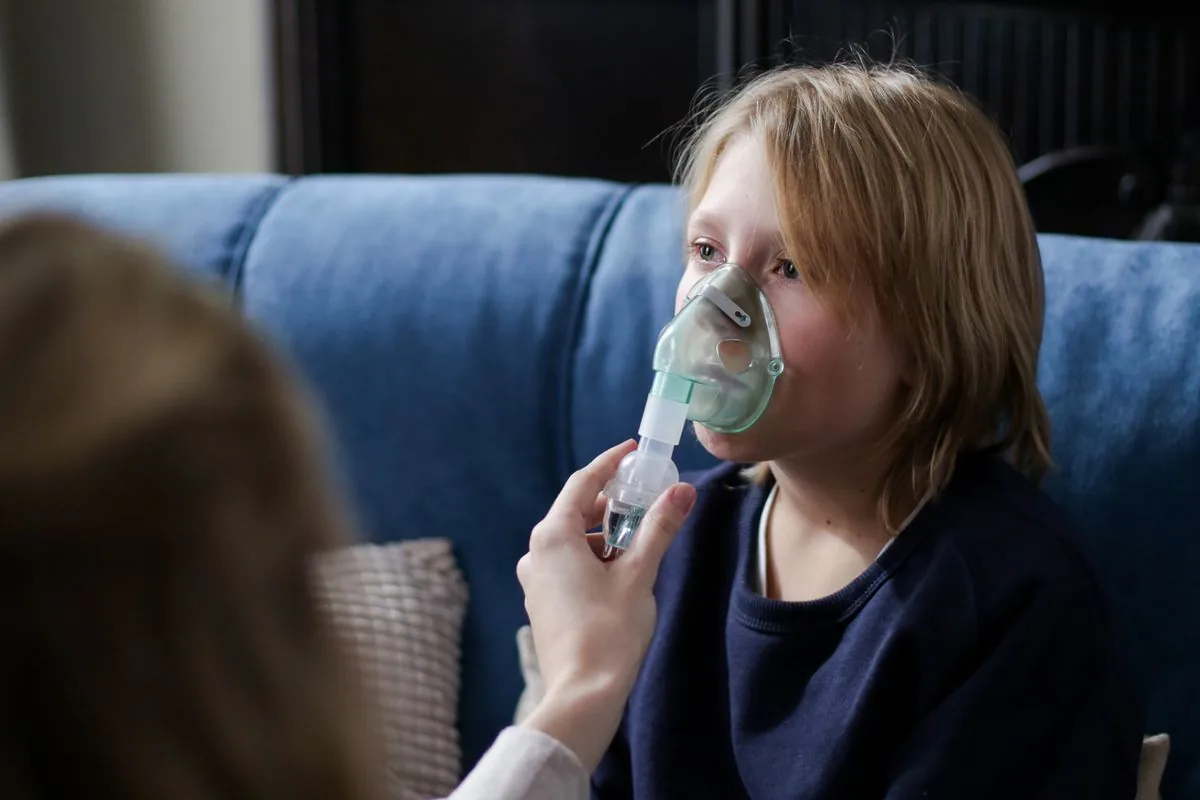
Up to four or five years, a spacer with a face mask covering nose and mouth, well sealed, held in place for ten seconds or about six breaths. After that, a spacer with a mouthpiece between the teeth and lips closed around it. In both cases, one puff at a time and half a minute's wait before the next.
Tobacco smoke at home is not negotiable
Smoking on the balcony or by an open window does not protect the child: the particles settle on clothes, hair and soft furnishings. In a child with asthma, exposure to smoke increases attacks, blunts the response to treatment and multiplies emergency visits. Of all the environmental measures, it is the one with the strongest evidence behind it and the one that depends on the family alone.
PE, sport and asthma
A child whose asthma is well controlled does PE like everyone else and can compete. The notion that asthma and sport do not mix has done more harm than good: keeping a child away from activity worsens their fitness, and the poorer the fitness, the sooner the breathlessness arrives.
What does help: warming up for ten to fifteen minutes before hard effort, avoiding outdoor exercise on very cold or heavily polluted days, and keeping the reliever inhaler at the sports hall rather than in a bag in the changing room. If the child coughs or wheezes every time they run, the problem is not the sport: the underlying treatment is not right and needs reviewing.
What to do in the weeks before term starts
A short list, in order of usefulness:
- Restart the preventer if it was dropped, and do it now rather than on the first day of term: inhaled steroids need days to calm the airway.
- Check expiry dates and doses left on every inhaler, including the reliever in the school bag.
- Book an appointment to review technique and update the written action plan.
- If the child has never been formally assessed, use these weeks for spirometry and allergy testing before term begins.
- Air and deep-clean the bedroom, wash bedding at 60 degrees and air out school kit that has been in storage.
- Shift sleep back to term-time hours before day one: sleeping badly lowers the threshold for everything, asthma included.
If you want to cross-check all this against independent sources, the MedlinePlus page on asthma in children, from the US National Library of Medicine, and the NHS guide to asthma cover the same ground in plain language.
Frequently asked questions
Because three things converge within a few weeks. Cold viruses, rhinovirus above all, start circulating again as soon as children share a classroom, and they are the number one trigger of attacks in childhood. Rooms that have been shut all summer are opened at once, releasing dust and mites. And many children have spent the summer without their preventer treatment, so the airway reaches September more inflamed than it should be. Together they explain the spike that repeats year after year.
It can be suspected and it can be treated, but at that age the diagnosis is clinical: no single test confirms it definitively. The paediatrician relies on repeated episodes of wheezing, on whether they improve with a bronchodilator, on a family history of asthma or allergy and on whether the child has atopic dermatitis. Many toddlers wheeze only when they catch a virus and stop doing so by around six; others carry on. Follow-up is what eventually tells the two paths apart.
Usually from five or six, because the test requires following an instruction and blowing out hard right to the end, and that is not achievable earlier. With a technician used to children, some manage it well at four. At Clínica Eupnea children's spirometry is done in a child-friendly setting and is often repeated after a bronchodilator: if the values improve significantly, that response is one of the strongest arguments in favour of an asthma diagnosis.
Almost every family asks this and it deserves an honest answer. There is an effect and it is small: it is concentrated in the first year of treatment, amounts to roughly half a centimetre of growth velocity, and in the longest follow-up available it translated into a little over one centimetre of adult height. It is neither cumulative nor progressive. Against that sits what poorly controlled childhood asthma causes: attacks, emergency visits, broken nights, missed school and courses of oral steroids, which weigh a good deal more. That is why the lowest dose that keeps the child well is used, and it is reviewed regularly.
Yes, well into adolescence. The spacer solves the real problem with pressurised metered-dose inhalers, which is coordinating the puff with the breath in; without one, much of the drug stays in the mouth and throat. With a spacer far more medicine reaches the lung and there are fewer local effects such as hoarseness or thrush. Up to four or five years of age it is used with a face mask; after that, with a mouthpiece. One puff at a time, with five or six breaths after each.
They should. A child whose asthma is well controlled does exactly what everyone else does, competitive sport included. If they tire sooner, cough or wheeze every time they run, the message is not to drop the activity but that the treatment needs adjusting. What does help is warming up for ten minutes beforehand, avoiding hard exercise on very cold or very polluted days, and keeping the reliever inhaler at the sports hall rather than inside a bag in the changing room.
Not automatically. Environmental measures are only worth the effort when sensitisation to that specific allergen has been demonstrated, and that comes from a test, not from a hunch. If testing confirms house dust mite allergy, mite-proof covers on the mattress and pillow and washing bedding at 60 degrees make sense. If it confirms dog dander allergy, it is a conversation to have calmly with the family. Making big changes at home without knowing what the child is allergic to is usually wasted effort.
Want to reach September with your child's asthma under control?
At Clínica Eupnea, in Palamós, the paediatrician can review the treatment, check inhaler technique and carry out spirometry and allergy testing before term starts.
Book Appointment