
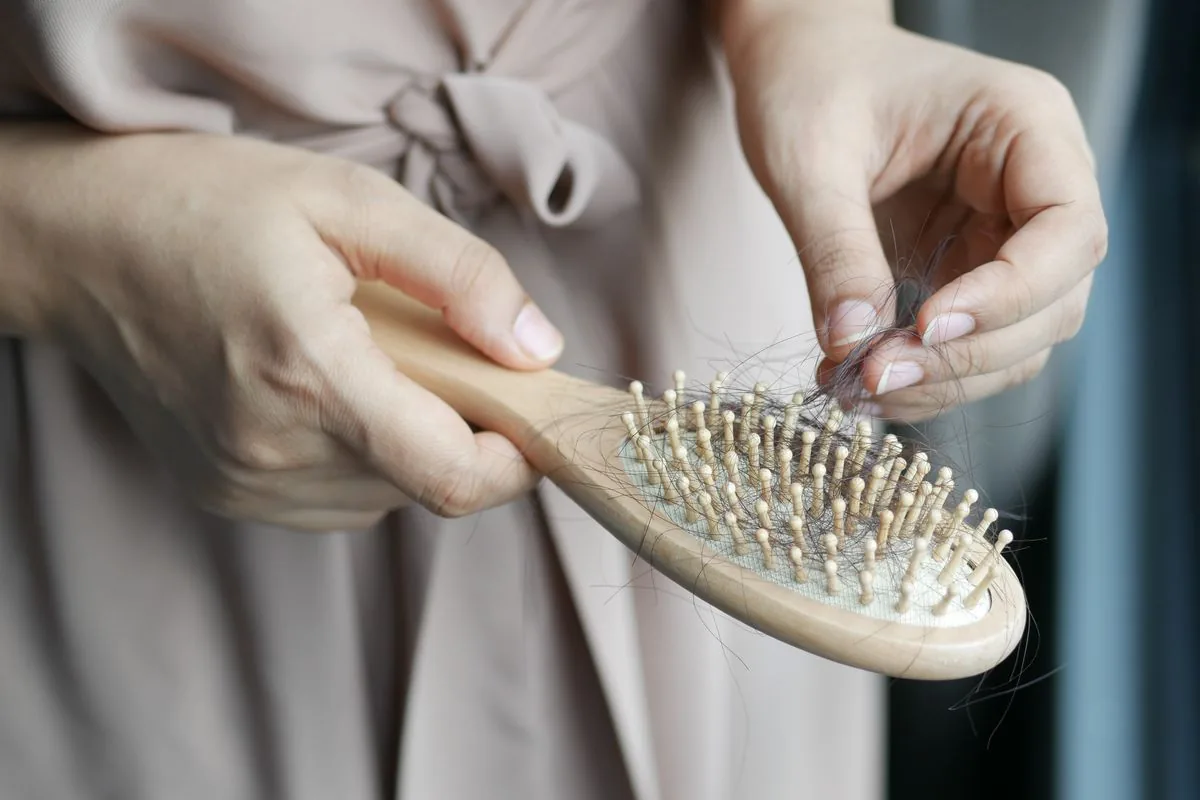
It always starts the same way. One September morning you run your hand through your hair and four strands come away between your fingers. The shower drain holds more hair than you remember and the elastic goes round one extra turn compared with June. The first reaction is to stand in front of the bathroom mirror looking for a bald patch that, almost always, is not there yet.
Autumn hair loss is one of the most repeated reasons for a September or October appointment, and the vast majority of the time it comes down to a phenomenon that is well known, measured and reversible. Not all of them are, though. Telling seasonal shedding apart from the kind that hides something else is straightforward once you know what to look at, and that is exactly what follows.
What you will find in this article
- How much hair it is normal to lose each day
- Why more hair falls out in autumn
- Telogen effluvium: the shedding that arrives three months late
- When hair loss is no longer seasonal
- What to look for in a blood test
- Hair loss in women: postpartum, menopause and hormones
- The scalp counts too
- What can be done at the clinic
- Hair loss: what helps at home and which myths do not
- When to book an appointment
- Frequently asked questions
The key points in thirty seconds
- Shedding around a hundred hairs a day is within normal range; what matters is the change compared with a month ago, not the number.
- The peak in resting-phase hairs falls in late summer and the visible shedding arrives one to two months later: September and October.
- Telogen effluvium shows up two or three months after whatever triggered it: a high fever, childbirth, a harsh diet, surgery or a rough patch.
- Diffuse shedding is usually reversible; patchy loss, bald spots, or a red and painful scalp should not wait.
- Ferritin and thyroid function are the two results that most often explain shedding that will not stop.
- Hair treatments work better as support than as a stand-alone answer, and they never replace treating the cause.
How much hair it is normal to lose each day
The figure usually quoted is about a hundred hairs a day. It appears, among other places, in the MedlinePlus page on hair loss, from the United States National Library of Medicine. It is a rough guide and there is no need to count.
The reason is that hair does not grow in step. Each follicle runs on its own schedule through three phases: a long growing phase, a very short transitional one, and a resting phase lasting around three months that ends with the hair falling out to make room for the next one. A healthy scalp has, at any moment, between 5 and 15 per cent of its follicles at rest. That percentage is what rises and falls across the year.
How to track hair loss without obsessing over it
Counting hairs ends badly: it turns into an anxiety ritual that adds nothing. There are more useful ways to follow it. The first is to photograph your parting and crown once a month in the same light and the same position; real change shows up when you compare photographs, not when you stare in the mirror every day. The second is to notice the thickness of your ponytail: if the elastic goes round one more time than it did six months ago, there is an objective loss of density.
Why more hair falls out in autumn
Hair shedding more in autumn is not a hairdresser's legend. Several studies followed healthy people for years, systematically plucking and counting hairs, and all of them found the same thing: the proportion of hairs in the resting phase reaches its maximum in late summer, and visible shedding follows one to two months behind. On a Mediterranean calendar that means September and October.
It is worth being honest about how far those data go. They are small series, mostly in healthy men and women from northern Europe, and they do not fully explain the mechanism. The most repeated hypothesis links the effect to photoperiod and accumulated daylight hours, a leftover of the seasonal coat that most mammals still have. Whatever the underlying reason, the pattern repeats year after year.
What a Costa Brava summer adds on top
On top of the physiological shedding comes everything the hair has been through between June and September. Hours of direct sun, salt, pool chlorine, hairdryers and straighteners on already stressed hair and, often, a few months of erratic eating and short nights. None of that pulls hair out at the root, but it does damage the fibre: hair breaks sooner, looks finer, and the sense of loss grows even when the number of follicles has not changed.
Telogen effluvium: the shedding that arrives three months late
This is the technical name for the most common type of diffuse shedding, and the key to understanding it is the delay. When the body goes through a demanding episode, many growing follicles switch abruptly into the resting phase. Because that phase lasts about three months, the hair does not fall then but a quarter of a year later, by which time the person has forgotten the original event and never connects the two.
The usual triggers are well known:
- A high fever or a significant infection, including viral illnesses that leave you flattened for a few days.
- Childbirth: postpartum shedding is the classic example and appears between the second and fourth month.
- Surgery or a general anaesthetic.
- A very restrictive diet or rapid weight loss, especially when protein intake is low.
- A stretch of intense stress or badly insufficient sleep kept up over time.
- Starting or switching certain medications, among them some anticoagulants, antithyroid drugs, retinoids and antidepressants.
The useful diagnostic move is to look three months back, not three days. If you had flu in May that kept you in bed for five days, the August shedding may well come from there. This kind of loss is diffuse (it comes from the whole head, not one area), it stops on its own and the hair recovers, even if the recovery is slower than anyone would like.
When hair loss is no longer seasonal
Some signs move the case out of seasonal territory and into a consultation that should not wait for spring.

- Round, sharply defined bald patches that appear quickly, on the scalp or in the beard: that is the pattern of alopecia areata and it needs assessment.
- Redness, scaling, pain or pustules on the scalp. Where there is inflammation and the follicle is destroyed, the loss can be permanent, and time matters.
- A progressively widening parting or loss of density at the crown sustained over months: that points to androgenetic alopecia, which is not seasonal and has its own treatment.
- A clearly receding hairline in a young man.
- Shedding that is still as heavy after six months.
- Shedding alongside fatigue, cold intolerance, weight gain or loss, very heavy periods or brittle nails.
For an overview of the different types, the MSD Manuals page on alopecia describes them in plain language and without selling anything.
What to look for in a blood test
Faced with diffuse shedding that will not stop, blood work is the first tool and often the one that gives the answer. At Clínica Eupnea blood tests are done on site, with morning sampling and results explained in consultation.
Ferritin: the number most often misread
Ferritin measures stored iron and falls long before haemoglobin does. You can have a perfectly normal blood count and a practically empty iron store. There is an important nuance here: many laboratories flag anything above 10 or 15 ng/ml as normal, while much of the dermatology literature places the useful threshold for hair considerably higher, between 30 and 40, and some authors higher still. There is no single agreed figure. That is why the value is read with the person in front of you: a 25 in a woman with heavy periods and six months of shedding is not the same as the same 25 in someone with no other symptom.
Thyroid, vitamin D and the rest of the panel
Thyroid function is the other usual suspect. Both an underactive and an overactive thyroid cause diffuse shedding, and hair is often the first reason someone books an appointment at all. If you want to understand how they present, we cover it in the article on thyroid problems. Vitamin D, vitamin B12, zinc and, in women with signs of androgen excess, a hormone study are usually added. Anything beyond that is requested according to what each patient describes, not as routine.
Hair loss in women: postpartum, menopause and hormones
During pregnancy hair usually looks its best, because hormone levels stretch out the growing phase. After delivery those levels drop sharply and all those follicles that had been running on extra time enter the resting phase together. The result is postpartum shedding, which tends to start around the second or third month, is genuinely frightening and resolves on its own across the first year.
Menopause is a different situation. Falling oestrogen leaves the androgenic effect more exposed and hair tends to thin over the top of the head while the frontal hairline holds. This is not a passing effluvium but a progressive change, and it is handled differently. Other symptoms usually appear alongside the hair, and they are worth putting in context: we go through them in the menopause guide.
The scalp counts too
A very common mistake is to treat the hair and forget the skin it grows out of. A scalp with scaling, itching or redness keeps up a background inflammation that makes any shedding worse, however good the hair treatment applied on top of it.
The most frequent cause is seborrhoeic dermatitis, which comes in flares and often worsens with the change of season and with stress. It is well controlled, but it needs its own consistent treatment; we cover it in depth in the article on seborrhoeic dermatitis. Scalp psoriasis belongs here too and, in children, fungal infections, which require oral treatment. If your scalp itches, flakes or hurts to the touch, that part gets sorted out first.
Hair does not come back at the speed you would like
A hair grows roughly one centimetre a month. Even if the shedding stops today, new hairs take months to become visible and, in the meantime, they turn up as short unruly strands along the hairline that many people mistake for breakage. They are a good sign. Any hair treatment, whichever it is, has to be judged against that calendar: nothing can be assessed before three or four months.
What can be done at the clinic
The first part of the job is always diagnostic: looking at the scalp, assessing the pattern of the loss, reviewing medication and ordering blood work. From there, the aesthetic medicine unit in Palamós assesses which hair treatments make sense in each case.
Hair biostimulation
Hair biostimulation means delivering active ingredients, vitamins and nutrients straight to the follicle through microinjections into the scalp. The aim is to improve the environment the hair grows in, gain density and hair quality and slow the shedding. It is done in sessions and works better as part of a complete plan than as an isolated gesture.
Hair PRP
Hair PRP uses platelet-rich plasma obtained from a small blood draw from the person themselves. It is spun to concentrate the growth factors and applied to the scalp. The logic is to stimulate follicles that are still viable. It works best in early alopecia, needs several sessions plus maintenance, and does not create hair where the follicle is already lost. Put like that, without over-promising, it is a reasonable tool.
Treating the cause, which is what changes the outcome most
No hair treatment compensates for rock-bottom ferritin, an uncontrolled underactive thyroid or a diet without enough protein. Where there is a correctable cause, correcting it is what turns the situation around; everything else is support. That is the difference between a medical approach and a purely cosmetic one, and the reason the blood test comes before the first session.
Hair loss: what helps at home and which myths do not
Things with a real, if modest, effect:
- Eating enough protein every day. Hair is essentially keratin, and very low-protein diets show up on your head within a few months.
- Washing your hair as often as your scalp asks for, without fear. Spacing washes out does not save a single strand.
- Easing the mechanical tension: very tight ponytails, aggressive clips and long-worn extensions eventually cause traction alopecia, particularly at the temples.
- Turning the hairdryer temperature down and using straighteners less during the heaviest weeks.
- Sleeping enough and dealing with sustained stress, which is a genuine factor and not an excuse.
Myths that keep going round
Cutting your hair does not make it grow back thicker: thickness is decided at the root and all the scissors do is remove split ends. Anti-hair-loss shampoos improve the state of the scalp, but none of them puts new hair on your head; the contact time during a wash is far too short for anything more. And the idea that shedding comes from "poor circulation" in the scalp and can be fixed with vigorous massage does not hold up: if anything, rubbing hard at an irritated area makes it worse. The NHS page on hair loss sets out what is worth trying and what is not.
When to book an appointment
There is no need to rush for three weeks of diffuse shedding in September. It is worth booking if any of these apply: the shedding has lasted more than three months, there are bald patches or areas without hair, the scalp hurts or is red, it comes with fatigue or other general symptoms, the parting has clearly widened, or you have simply been turning it over for months. One appointment with blood work usually closes the question far sooner than six months of guessing on your own.
Frequently asked questions
Around a hundred, and it is not a figure worth counting. Hair does not grow in unison: every follicle runs its own cycle and, at any given moment, between 5 and 15 per cent of them are resting and waiting to shed. That is why you always find hair on the brush, on the pillow and in the drain. What really matters is not the exact number but the change: if this month is clearly worse than last month and it lasts for weeks, it deserves a look.
Yes, and it has been described in studies that followed healthy people for years, measuring how many hairs were in the resting phase. The proportion peaks in late summer and the visible shedding follows one to two months later, which lands in September and October. These are small studies and they do not fully explain the mechanism (daylight hours and photoperiod are the usual suspects), but the pattern repeats. Seasonal hair loss is real, unsettling and, in principle, temporary.
Between six weeks and three or four months in most cases, and then it settles on its own. New hair takes a while to show: since it grows roughly one centimetre a month, the first short hairs along the hairline are not visible for several more weeks. If the shedding is still as heavy after six months, it can no longer be blamed on the season and the cause needs looking into.
No. The hair that comes out with the shampoo had already detached from the follicle; washing simply releases it all at once instead of spreading it through the day. Leaving long gaps between washes is usually more alarming, because three days' worth of shedding shows up in the drain together. A scalp that is greasy or flaky does not help either: scaling and itching make shedding worse, not better.
The basic panel usually covers a full blood count, iron and ferritin, thyroid function (TSH and free T4) and vitamin D; depending on the case, B12, zinc, liver and kidney function and, in women with other symptoms, a hormone profile are added. Ferritin is the most informative because it drops long before haemoglobin does: you can have a normal blood count and an empty iron store. At Clínica Eupnea the sample is taken on site and the results are discussed face to face, which is the part that actually matters.
They can help in selected cases, especially in early alopecia where the follicles are still alive, and when they are used as support rather than as a magic fix. Hair PRP concentrates the growth factors from your own blood and delivers them into the scalp; hair biostimulation brings nutrients and active ingredients straight to the follicle. Neither creates hair where the follicle is already gone, neither replaces treating the underlying cause, and both need several sessions plus maintenance. With those cards on the table, they are worth discussing in consultation.
They help if you are short of what they contain. Biotin deficiency is very rare in anyone eating normally, and taking extra does not grow more hair; it can also skew thyroid and cardiac marker assays and send a doctor down the wrong path, so mention it if you take it. Iron supplements do work when stores are low, but they are taken with a result in front of you and under supervision, not on a hunch. Before buying a jar, the money goes further on a blood test.
Losing more hair than seems normal to you?
At Clínica Eupnea in Palamós we assess the scalp, order the right blood work and tell you whether a hair treatment is needed or not.
Book an Appointment