
With the cold and the heating on, many families notice it on their children's skin: more dryness, more itching and nights of scratching. Plenty of adults notice it too. Atopic dermatitis comes in flare-ups, and winter brings together several of its triggers.
We look at what it is, how to recognise it in babies, children and adults, why it gets worse in winter, which skin care routine really works, how flare-ups are treated and when to think about an allergy. We also take apart a few myths, such as the fear of steroid creams.
In this article
The essentials in one minute
- Atopic dermatitis is a long-term skin condition that causes dryness, intense itching and inflammation, and comes in flare-ups. It is not contagious.
- According to the MSD Manual, up to 20% of children and up to 10% of adults are diagnosed with it each year. It usually starts before the age of 5, often in the first year.
- Dry air, cold and indoor heating can irritate the skin and trigger flare-ups. Sudden changes in temperature and wool do not help either.
- The foundation of treatment is emollients, every day and also when the skin is clear: they lengthen the time between flare-ups.
- For flare-ups, topical corticosteroids as prescribed: in short courses they have not been shown to thin the skin.
- If blisters, crusts, pus, pain or fever appear, get seen the same day.
What atopic dermatitis is
Atopic dermatitis is a long-term skin condition that causes inflammation, dryness, itching and redness. According to Canal Salut, the Catalan government's health portal, it is the most common type of eczema, especially in babies and young children, but it can also persist into adulthood or start then. It comes in flare-ups that alternate with calmer spells, and in many cases it improves with age.
The exact cause is not known. There is a genetic predisposition that affects the skin barrier, the layer that stops us losing water and keeps out irritants, germs and allergens. That is why it is more common if your parents had eczema or if asthma or hay fever runs in the family. And atopic dermatitis itself makes it more likely to develop asthma or allergic rhinitis later on.
Eczema, atopic skin, atopic dermatitis: are they the same?
In practice, yes. Eczema is a general term for inflammation of the skin, but it is often used to mean atopic dermatitis, and "atopic skin" is the everyday way of saying it. There are other, different types of eczema, such as contact dermatitis, which has its own causes and treatment.
How many people have atopic dermatitis
According to the MSD Manual, it is one of the most common skin conditions, especially in children who live in cities or in high-income countries. Up to 20% of children and up to 10% of adults are diagnosed with it each year. Most people develop it before the age of 5, and many before their first birthday: it usually starts from around 3 months of age.
Symptoms of atopic dermatitis in babies, children and adults
The main symptom is itching, often intense. The skin feels dry, turns red, becomes irritated and inflamed, often because of scratching. There may be blisters that weep and crust over, small bumps, scaling or patches of thickened skin. Depending on skin tone, eczema can look red, whitish, purple or grey, or lighter or darker than the surrounding skin.
Where it appears depends on age:
- Babies: on the face, especially the cheeks, and on the scalp; also on the arms and legs.
- Older children and adults: in the skin folds (the inside of the elbows and behind the knees), on the hands and on the feet.
The UK's NICE guideline notes that in Asian, Black African and Black Caribbean children, atopic dermatitis can affect the outer sides of the arms and legs rather than the skin folds, and round patches or patterns around the hairs may be more common. After a flare-up, the skin may stay temporarily darker or lighter.
The itch-scratch cycle
The more you scratch, the more inflamed the skin becomes and the more it itches, and that cycle makes the flare-up worse. Scratching also opens small wounds that let bacteria in. To break it: keep nails short, use scratch mittens on babies and, when it itches, rub gently with a finger instead of scratching. If the itching keeps you or your child awake, tell your doctor: the treatment may need reviewing.
Why atopic dermatitis gets worse in winter
The American Academy of Dermatology sums it up: dry air, cold temperatures and indoor heating irritate the skin and can make atopic dermatitis flare. In winter, other triggers identified by the NHS and by Canal Salut, the Catalan health portal, add up:
- sudden changes in temperature, such as going from the cold street into a house with the heating turned up;
- dry skin, which is more common in winter;
- wool and synthetic clothing, and rough fabrics;
- heat and sweating, for example from wrapping up too warmly;
- very hot showers.
One caveat: the NICE guideline admits that it is unclear how much humidity and extremes of temperature contribute to flare-ups, although it advises avoiding them where possible. American dermatologists, for their part, recommend small changes to the skin care routine at the first sign of winter.
Other triggers worth knowing
All year round, atopic dermatitis can get worse with:
- soaps, detergents, shampoos, bubble baths and shower gels, as well as colognes and perfumes, especially if they contain alcohol;
- allergens in the environment, such as house dust mites, pollen, pet hair or mould spores;
- in people who are sensitised, some foods, such as cow's milk protein or egg;
- stress, skin infections, tobacco smoke and hormonal changes, for example during pregnancy.
Caring for atopic skin in winter
Daily skin care is a key part of treatment. These are the guidelines used by the NHS, Canal Salut and the American Academy of Dermatology:
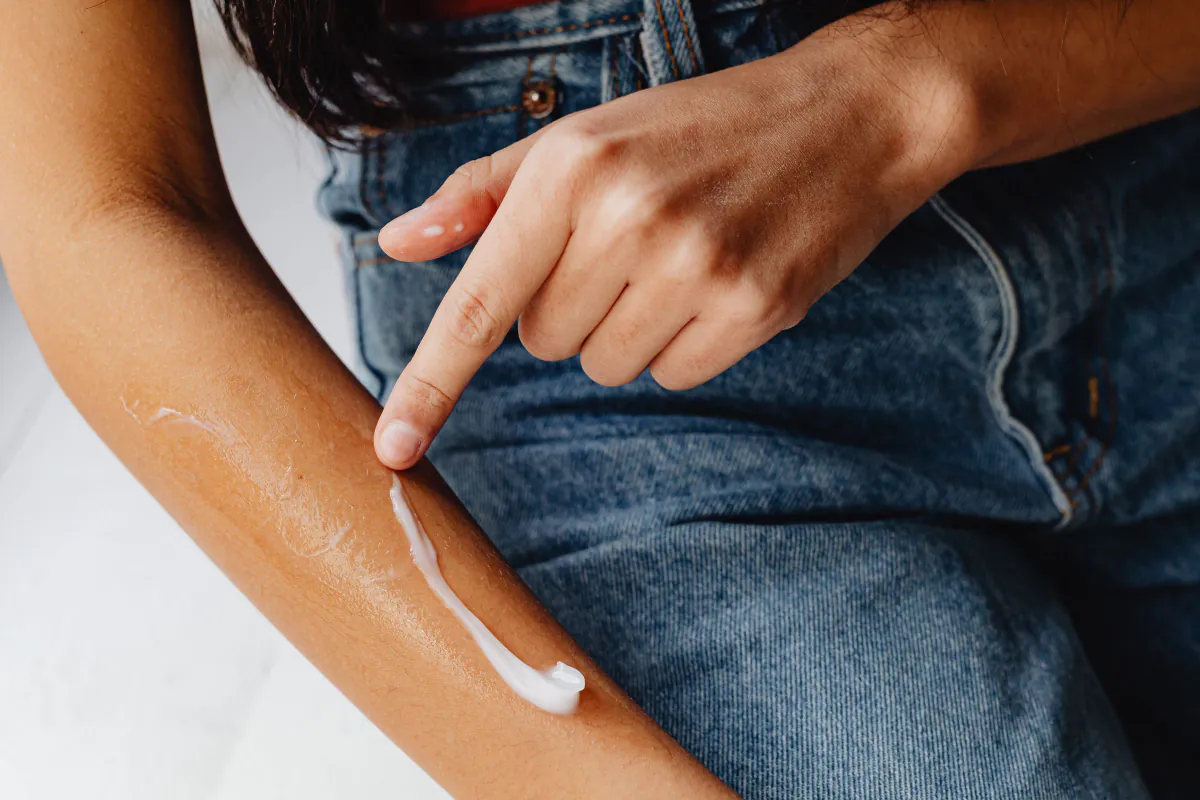
- An emollient every day, at least twice a day, and more often in winter: after every bath or shower, after washing your hands and before bed. And keep going even when the skin improves.
- Apply it while the skin is still damp, within 3 minutes of the shower. If the skin is very dry, ointments hold more water than creams.
- Short showers in lukewarm, not hot, water, with a gentle soap or an emollient wash instead of soap. Pat the skin dry without rubbing.
- Cotton clothing and, in winter, layers that can come off if you get too warm. No wool against the skin.
- Do not sit too close to radiators, heaters or open fires, and do not turn the heating up so high that you overheat.
- Take off wet clothes and shoes as soon as you get home, and wear cotton gloves outdoors.
Two practical tips from the NHS: do not put your fingers into the emollient tub (use a spoon or a pump dispenser instead) and do not share it. And be careful with fire: emollients are not flammable on the skin, but when they soak into clothing, bedding or dressings, those fabrics catch fire more easily. If you use a lot, do not smoke or go near naked flames.
Does moisturising every day really help?
Yes, and there are data. A 2017 Cochrane review brought together 77 studies with more than 6,600 participants. In the studies that compared using a moisturiser with using nothing, people who used one had fewer flare-ups and took longer to have the next one (a median of 180 days, compared with 30), and needed less corticosteroid. The quality of the evidence is low, but the result matches what the guidelines recommend: emollients are the foundation of treatment.
Treating atopic dermatitis: what is used for flare-ups
Treatment works in steps according to severity. Emollients are always there, even when the skin is clear, and other treatments are added on top as needed:
- Topical corticosteroids in a cream or ointment, the main treatment for flare-ups. They are applied once or twice a day, and the strength is chosen according to the area and the severity; on children's face and neck, NICE advises mild ones and not using potent ones there.
- Tacrolimus and pimecrolimus, topical anti-inflammatories without steroids.
- For moderate or severe dermatitis that does not respond, phototherapy or medication by mouth, and in the most severe cases, biologic drugs or other targeted treatments, prescribed through hospital.
Once the flare-up settles, the doctor may keep up a treatment plan to prevent relapses. For children, NICE does not recommend routine oral antihistamines; if the itching is very intense, the doctor may try one for a month. During pregnancy and breastfeeding, emollients and topical corticosteroids are the treatments of choice.
Steroid creams: what the evidence says
Many people are afraid of steroid creams, but the data are reassuring. A 2024 Cochrane review of 291 studies and more than 45,000 participants ranked potent steroids among the most effective topical treatments and found no increase in skin thinning with short courses, whatever the strength. With continuous use for 6 months to 5 years, skin thinning appeared in 6 of 2,044 participants, or 0.3%. The key is to use them as your doctor prescribes: no more and no less.
Atopic dermatitis and allergy: should you get tested or cut out foods?
Atopic dermatitis is not an allergy to one particular substance, but it often comes with asthma or allergic rhinitis. We cover both in our articles on childhood asthma and on allergic rhinitis caused by dust mites.
With food, however, care is needed. The NHS advises against changing your diet, including while breastfeeding, unless a doctor tells you to. The NICE guideline only considers food allergy in two situations: when there are immediate symptoms after eating a particular food, and in babies and young children with moderate or severe eczema that is not controlled by good treatment, especially if they have colic, vomiting, changes in their bowel habits or are not growing well. Most children with mild eczema do not need allergy tests, and the allergy tests sold in shops or online have no proven value for eczema.
When it is worth investigating, an allergist does it with tests such as the skin prick test or specific IgE blood tests.
Can atopic dermatitis be prevented in babies?
So far, putting moisturiser on a baby every day from birth has not been shown to prevent it. Two large trials published in The Lancet in 2020 tested it: in the English BEEP trial, with 1,394 babies who had a close relative with eczema, asthma or allergic rhinitis, 23% of those moisturised daily had eczema at age 2, compared with 25% of those who were not, and the first group had more skin infections. The Scandinavian PreventADALL trial, with 2,397 babies, found that it did not prevent eczema either. A 2022 Cochrane review agrees.
When to see a doctor and when it is urgent
It is worth seeing a doctor if there are symptoms of atopic dermatitis, if treatment is not working or if the itching stops you sleeping. At Clínica Eupnea, the assessment can be done by paediatrics, if it is a child, or by dermatology.
Get seen the same day if, with atopic dermatitis:
- blisters, crusts, oozing or pus spots appear;
- the skin is painful, warm or swollen;
- the flare-up suddenly gets worse or spreads quickly;
- there is a fever or you feel generally unwell.
These can be signs of an infection or of eczema herpeticum, a complication caused by the herpes virus that leads to widespread dermatitis, blisters and a high temperature. It needs treatment the same day, and if it affects the eyes, an eye specialist should see it too.
Myths about atopic dermatitis
"It's contagious." No. It is not passed on by contact or by sharing clothes.
"Steroid creams thin the skin." In short courses, the 2024 Cochrane review found no increase in skin thinning. With continuous use over months or years, it happened in 0.3% of participants.
"You have to cut out milk or eggs." Only if a doctor advises it, and only in specific cases. Cutting out foods without a reason is not recommended and can unbalance a child's diet.
"If the skin is fine, you don't need the cream any more." The opposite: keep using emollients when the skin is clear, because they lengthen the time until the next flare-up.
"Moisturising a baby from birth prevents eczema." The BEEP and PreventADALL trials say it does not.
How we can help at Clínica Eupnea
In Palamós you can treat atopic dermatitis for the whole family in one place:
- the dermatology clinic with Dr Teresa Martín-Urda, who draws up personalised treatment plans for atopic dermatitis and offers phototherapy, oral medication and topical treatments to control flare-ups;
- paediatrics with Dr Montse Vazquez, for babies and children with atopic skin;
- allergology with Dr Carolina Escobar, when a food or environmental allergy is suspected.
If you are not sure whether you have atopic dermatitis or psoriasis, our article on psoriasis in winter explains how they differ.
Dermatologist in Palamós for atopic dermatitis
Book an appointment on 872 21 75 91 or by WhatsApp on 650 489 884, Monday to Friday from 9.00 to 13.30 and from 15.30 to 19.30, at Passeig del Mar, 41, Palamós.
Frequently asked questions
There is no cure, but treatment helps to control it. In many children it improves with age, although not all of them grow out of it: the UK's NICE guideline points out that it may get worse in the teenage years or adulthood. It can also start later in life.
According to the American Academy of Dermatology, dry air, cold temperatures and indoor heating irritate the skin and can trigger flares. Winter also brings more sudden changes in temperature, more wool clothing and hotter showers, all known triggers.
The foundation is an emollient every day, at least twice a day and also when the skin is clear. For very dry skin, ointments hold more water than creams. During flares, the doctor adds a corticosteroid or another topical anti-inflammatory with a specific plan.
Used as your doctor prescribes, the risk is low. A 2024 Cochrane review of 291 studies found no increase in skin thinning with short courses; with continuous use over months or years, it happened in 0.3% of participants. They are applied once or twice a day, and the strength depends on the area and how severe the eczema is.
No, unless a doctor says so. NICE only considers food allergy when there are immediate symptoms after eating a food, or in babies with moderate or severe eczema that is not controlled, especially if they have colic, vomiting or poor growth. Most children with mild eczema do not need allergy tests.
No. It is not passed on by contact or by sharing clothes. What can happen is that a scratched area becomes infected; if so, see a doctor.
If blisters, crusts, oozing or pus spots appear, if the skin is painful, warm or swollen, if the flare suddenly spreads, or if there is a fever or you feel unwell. It may be an infection or eczema herpeticum, which needs treatment the same day.
Does the cold make your atopic skin flare?
At Clínica Eupnea in Palamós, our dermatologist assesses the flare-up, adjusts the treatment and walks you through a skin care routine for a calmer winter, whether it is for you or for your child.
Book an Appointment